
Corporate Body
Royal Victorian Eye and Ear Hospital (1961 - )
- From
- 1 January 1961
- Functions
- Hospitals or Clinics, Ophthalmology and Otolaryngology
- Website
- http://www.eyeandear.org.au/
Summary
The Royal Victorian Eye and Ear Hospital succeeded the Victorian Eye and Ear Hospital in January 1961 when "Royal" was added to its name. It's earliest predecessor was the Eye and Ear Institute which opened in 1863. Australia's only specialist eye, ear, nose and throat hospital, in 2013 the Hospital celebrated 150 years of continuous service since the Institute was established.
Related entries
Timeline
1873 - 1961 Victorian Eye and Ear Hospital
1961 - Royal Victorian Eye and Ear Hospital
Archival resources
National Film and Sound Archive of Australia
- Graeme Clark/bionic ear collection [National Film and Sound Archive of Australia], 1956 - 2009; National Film and Sound Archive of Australia. Details
The University of Melbourne Archives
- Department of Otolaryngology - Bionic Ear Records, 1949 - 2000, 2004.0043 at U77/46-55; The University of Melbourne Archives. Details
Published resources
Books
- Donovan, P. F., An ornament to the city: the Royal Victorian Eye and Ear Hospital (East Melbourne: Royal Victorian Eye and ear Hospital, 1992), 265 pp. Details
- Gardiner, Lyndsay, The eye and ear: The Royal Victorian Eye and Ear Hospital centenary history (Melbourne: Robertson & Mullens, 1968), 114 pp. Details
Resources
- Wikidata, http://www.wikidata.org/entity/Q16899492. Details
- VIAF - Virtual International Authority File, OCLC, https://viaf.org/viaf/144750888. Details
- The Royal Victorian Eye and Ear Hospital, The Royal Victorian Eye and Ear Hospital, 2011, http://www.eyeandear.org.au/. Details
- Trove, National Library of Australia, 2009, https://nla.gov.au/nla.party-474985. Details
See also
- Dyason, D., 'The medical profession in colonial Victoria, 1834 - 1901' in Disease, Medicine and Empire: Perspectives on Western Medicine and the Experience of European Expansion, Macleod, Roy and Lewis, Milton, eds (London: Routledge, 1988), pp. 194-216. Details
Digital resources
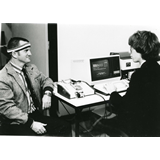
- Title
- Audiologist Richard Dowell tests first Cochlear patient Graham Carrick
- Type
- Image
- Date
- 1982
- Source
- Graeme Clark
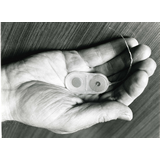
- Title
- Graeme Clark holding the mini-implant developed by Cochlear Ltd
- Type
- Image
- Date
- 1985
- Source
- Graeme Clark
Jack Roberts
Created: 5 September 2016, Last modified: 6 November 2025